
Summary
A conversation with Lightkeeper CEO Dean Schaffer on data infrastructure, the multiplier effect, and what funds don't want to hear.
Here is a question worth sitting with: if AI is only as good as the data underneath it, and most hedge funds still have fragmented, unreliable data infrastructure, what exactly are they buying when they invest in AI tools?
That is the uncomfortable starting point for a recent conversation between Hedgeweek and Dean Schaffer, CEO of Lightkeeper, a data analytics platform used by hedge funds and asset managers to organize, analyze, and query investment data. Dean leads a team that has spent over 15 years working on this problem across hundreds of client relationships. His view on where the industry actually stands is more grounded than most of what you will read on this topic.
The Industry Is Executing Now. But It Is Still Early.
When Hedgeweek asked Dean to give an honest read on where funds actually stand with AI in 2026, his answer was carefully calibrated. Firms have shifted from exploration to execution. Tools are being embedded into workflows in ways they weren’t even 6 months ago.
But he was deliberate about what that progress does and doesn’t mean. Funds are no longer just kicking the tires. They are incorporating AI into their workflows and executing on strategy. And yet, by no means does that mean everybody is fully integrated.
The perception of where AI is in asset management is running well ahead of the operational reality inside most firms. That gap is where most of the risk lives.
AI Will Not Fix Your Data Problem. You Have to Fix It First.
This is the part of the conversation that hedge fund COOs need to hear most, even if it is not what they want to hear.
Dean is direct: AI does not do a great job with calculations. It is built for word-based responses and pattern recognition. If you are expecting it to clean up fragmented, inconsistent data, you will be disappointed.
The frame he uses is simple. Garbage in, garbage out. The AI will return whatever information goes in. If that information is unreliable, the outputs will be too. And those outputs might look credible when they are not, which creates a different kind of risk than simply not having the answer.
You need to go on a data journey alongside your AI journey. The firms that treat these as sequential will get significantly more out of both investments.
At Lightkeeper, the architecture reflects this directly. The platform handles sophisticated calculations and maintains data integrity. The AI tools then pull answers from that system rather than performing the calculations themselves. That is why clients can trust what the AI surfaces: it is grounded in the same calculations they have relied on for years.
A recent client example illustrates the point.
One investment firm used Lightkeeper’s AI capabilities to run its year-end analyst performance reviews, a process that had traditionally required hours of manual work.
- The team asked a single question: analyze YTD analyst performance, including each analyst’s strengths and weaknesses.
- The output was a 5-page review of each Analyst identifying key performance drivers, highlighting where individual analysts were outperforming and why, and organized in a format the firm took directly into compensation discussions.
- The reason it worked was not the AI itself. It was that the underlying data was already clean, centralized, and reliable. The AI had something solid to work with.
One more thing worth stating clearly: AI will not replace investment decision-making for most firms. For the vast majority of firms it will be one input among several, still vetted by people. But this process shift actually raises the bar rather than lowering it. If your team is going to act on AI outputs, the trust threshold for those outputs is extremely high, which brings you back, again, to the quality of the data underneath them.
The Gap Between Large Firms and Everyone Else Will Widen If You Wait
The large, multistrat mega-managers are investing heavily in AI infrastructure with dedicated teams and serious resources. Dean is careful not to overstate what that means for smaller managers, but he is unambiguous on one point:
If you don’t integrate AI into your workflows, the gap will widen. You don’t need to match the large firms dollar for dollar. But you need to keep pace.
There is also an allocator dimension worth noting. Institutional allocators want to see institutionalized managers. When an allocator asks a detailed question about performance or positioning and you can answer it in seconds rather than days, that tells them your house is in order. That is a competitive advantage in fundraising that most managers are not thinking about.
What the Firms That Get This Right Will Look Like in Five Years
The firms that integrated AI well won’t look dramatically different from the outside. They will just be able to do more with the same team. More names covered, more ideas tracked, more insights surfaced from the same data.
That multiplier effect compounds over time into real competitive advantages:
- Broader coverage without adding headcount
- Faster, more detailed responses to allocator questions
- Better decisions from the same inputs
- A track record of operational rigor that allocators notice
That is exactly what platforms like Lightkeeper are built to enable. Not to replace the investment process, but to expand what the same team can see, cover, and act on.
The firms that are not making this move right now will still be focused on a narrower path when their competitors are operating with a much wider lens.
The Bottom Line
AI in asset management is not primarily a technology problem. It is a data infrastructure problem, a workflow problem, and an organizational prioritization problem. The technology is ready.
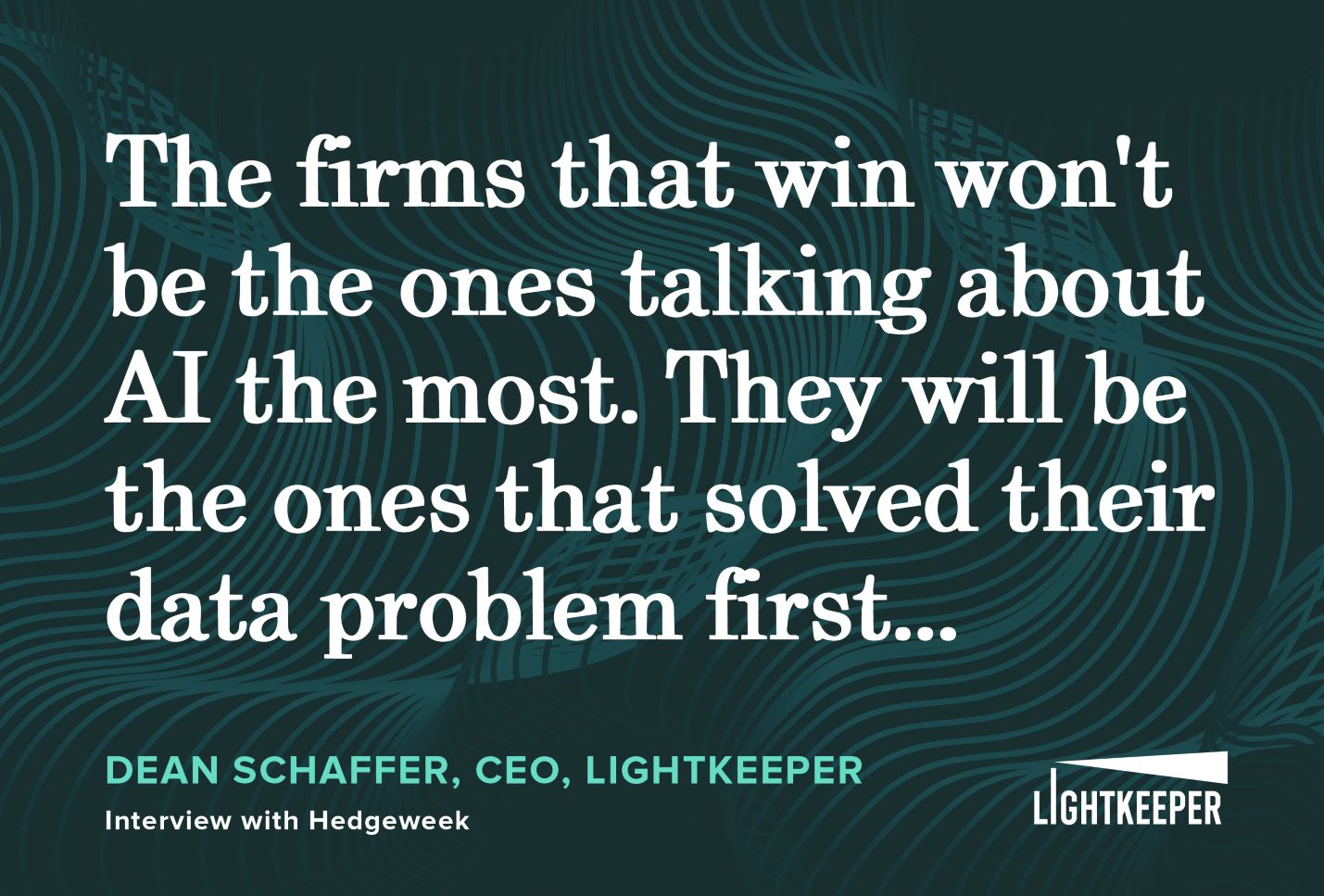
The firms that win won’t be the ones talking about AI the most. They will be the ones that solved their data problem first and then let AI do what it is actually good at.
Dean Schaffer is CEO of Lightkeeper, a data analytics platform for hedge funds and asset managers. This post is based on his recent interview with Hedgeweek. See the entire interview here.
