
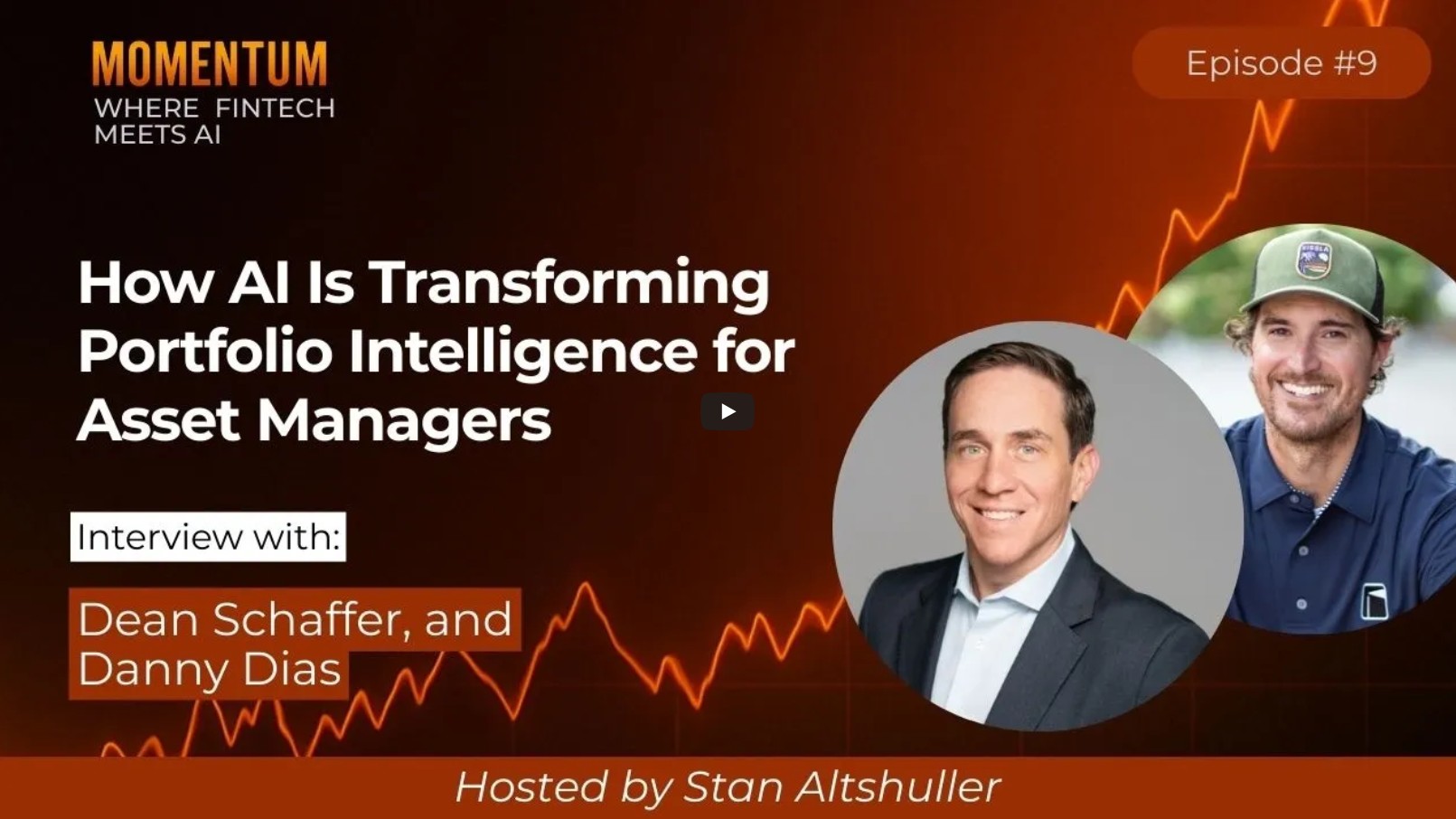
Insights from Dean Schaffer, CEO, and Danny Dias, Co-Founder & CPO of Lightkeeper
Ask any hedge fund manager today if they’re using AI, and the answer is almost universally yes. But as Lightkeeper’s CEO, Dean Schaffer pointed out in a recent episode of the Momentum Podcast, there’s a meaningful difference between saying you use AI and actually using it.
Dean and Co-founder & CPO Danny Dias joined host Stan Altshuller for a candid conversation on where the industry really stands: the data challenges that haven’t gone away, where AI is genuinely adding value, and what firms need to get right before they can benefit from any of it.
Here are the key insights from the conversation.
▶ Prefer to hear it in their own words? Listen to the full episode here.
1. Everyone Says They’re Using AI. Most Aren’t…Yet.
“I’m not sure how much they’re all using it. A lot of them are in the evaluation stage. We’re now in the execution stage and over the next several months, people are starting to make decisions about how to have AI in their workflow and how to leverage it.” — Dean Schaffer
Part of what’s driving the urgency is the sheer pace of change. Danny noted that since August alone, the ecosystem has seen six major model releases, and Model Context Protocol (MCP – which allows AI models to connect directly to live data) went from zero to 10,000 providers in under nine months. Asset management may not be a first-mover industry, Dean noted, but the window to get ahead of it is narrowing.
Underpinning all of it is a pressure Dean described as fundamental: the volume of data, LP requests, and reporting demands facing investment managers isn’t plateauing. It’s compounding.
“Fundamentally, I believe there’s more data than ever before and more requests for answers from that data than ever before. You put all that together and it creates an exponential challenge. My fundamental belief is that technology is the only way that you can solve those issues as it continues to grow.” — Dean Schaffer
2. Excel Is Not the Enemy, But It’s Not the Answer
One of the most grounded exchanges in the episode was Danny’s take on Excel, a tool Lightkeeper respects, but one that’s being asked to do far more than it was designed for.
“Excel is the Swiss Army knife of finance, but when it becomes your storage layer and your computation layer, you’re spreading your IP across individual sheets. That’s where the risk lives.” — Danny Dias
The deeper issue Danny identified is structural: firms often start lean, building on Excel because it’s flexible and familiar. But as they grow, those spreadsheets become the backbone of critical decisions, and the fragmentation and manual effort compounds. The shift Lightkeeper enables is toward structured data environments where every seat in the firm (IR, CFO, PM, risk) is working from the same unified, accurate foundation.
3. Know Where AI Is Strong and Where It Isn’t
Danny introduced a critical distinction that defines where AI adds real value versus where it still falls short: deterministic versus non-deterministic data joins.
For performance, NAV, and trade data, 100% accuracy is non-negotiable, and AI is not a substitute for clean, reliable data pipelines. But for linking a portfolio event to relevant news stories, thematic research, or macroeconomic context? That’s where AI shines.
In practice, this is where teams start to see traction. Not by replacing core calculations, but by layering context on top of them, connecting what happened in the portfolio to what’s happening in the market, faster than they could manually.
“We’ve been doing demos where you say: here’s my portfolio, here’s what’s happened — now get me relevant news stories. Thematically close enough is good enough, and that’s where AI is very strong.” — Danny Dias
This framing is particularly relevant as Lightkeeper rolls out its MCP layer, enabling AI models to access and reason over a firm’s proprietary data in real time, without manual data wrangling.
4. Democratization Is Real, But Table Stakes Are Rising
One of the most thought-provoking exchanges in the episode centered on whether AI could level the playing field between large institutional managers and smaller emerging funds.
The answer was nuanced. The cost of access to the new technology has dropped dramatically, Danny cited the shift from a $70,000/year enterprise requirement for an MCP license to a five-seat team plan at $30/month. But both he and Dean cautioned that as tools become available to all, the baseline expectation rises too.
“What these tools allow smaller firms to do is tell their story better, be more responsive, and punch above their weight with how they interact with prospective and current LPs. That’s what makes this table stakes.” — Dean Schaffer
The caveat from both Dean and Danny was consistent: you can’t automate what isn’t there. Pointing AI at fragmented, siloed, or incomplete data won’t produce an edge; it’ll produce confident-sounding errors. The firms that will benefit most are the ones that have done the unglamorous work of getting their data infrastructure right first.
The Bottom Line
Lightkeeper has spent 15+ years working with investment managers across the full spectrum, from emerging funds to $60B+ institutions. Across all of them, Dean and Danny see the same pattern: the firms best positioned to benefit from AI are not necessarily the largest. They’re the ones that have treated data infrastructure as a strategic investment, not an operational overhead.
The pressure driving that investment isn’t going away. More data, more LP demands, more complexity: Dean described it as an exponential challenge that technology is the only practical answer to. The question for most firms right now isn’t whether to engage with AI. It’s whether their data foundation is ready for it.
